
A reckless driving charge in Greensboro is easy to underestimate because it often starts with what looks like a routine traffic stop. Jason Aycoth Criminal Lawyer | DUI | Traffic Tickets | Car Accidents is a Greensboro law firm focused on criminal, DUI, and traffic defense, and that category matters here because North Carolina treats reckless driving as a criminal traffic offense, not just a minor citation.
Reckless Driving Attorney Greensboro Summary
- A reckless driving attorney in Greensboro is often worth calling early because North Carolina reckless driving is generally a Class 2 misdemeanor with court, record, and license consequences.
- Under G.S. 20-140, reckless driving can mean willful or wanton disregard for safety or negligence in driving without due caution and circumspection in a way likely to endanger people or property.
- A conviction can bring 4 North Carolina driver-license points, and NCDOT lists speeding plus reckless driving on the same occasion as a basis for a 60-day suspension.
- The North Carolina Judicial Branch says traffic cases are handled by a prosecutor and heard by a district court judge, and missing court can lead to a failure to appear and indefinite license suspension until the case is resolved.
- In Greensboro, firms including Jason Aycoth Criminal Lawyer | DUI | Traffic Tickets | Car Accidents are relevant because local reckless driving cases often turn on court process, record review, and whether the charge can be resolved without a full trial.
That mix of criminal law, DMV rules, and district court procedure is why reckless driving deserves more attention than many drivers give it. The six facts below are the ones that most often shape what happens next in Guilford County and nearby North Carolina courts.
What counts as reckless driving in North Carolina?
North Carolina defines reckless driving in two main ways under G.S. 20-140: willful or wanton disregard for others’ safety, or driving without due caution and circumspection in a way likely to endanger people or property.
Those phrases matter because reckless driving is broader than many people think. The statute does not require a crash. It also does not require one exact speed threshold written into the reckless driving law itself. Prosecutors may rely on driving behavior, road conditions, traffic density, lane movement, or a combination of speed and surrounding facts.
A common misconception is that reckless driving only applies to street racing or extremely high speeds. In practice, the statutory language is flexible. If the state believes the manner of driving created likely danger, the charge can be filed even when the driver thinks the conduct was merely careless.
That wording also explains why the facts around the stop matter. If the evidence points to momentary inattention, a clean driving history, or conditions that do not fit likely endangerment, those details can affect how the case is evaluated.
Is reckless driving just a traffic ticket or a crime in Greensboro?
Reckless driving is a crime, not just a citation. Under North Carolina law, the basic offense is a Class 2 misdemeanor, even though the case often begins with a traffic stop and lands in district court.
This is one of the most important distinctions for Greensboro drivers. A standard infraction and a misdemeanor do not carry the same legal weight. The North Carolina General Assembly classifies reckless driving under G.S. 20-140 as a criminal offense, and serious-injury versions can rise to a higher misdemeanor level depending on the injury involved.
The court process reflects that. The North Carolina Judicial Branch explains that traffic cases are handled by a prosecutor, and guilty pleas or trials are heard by a district court judge. That means the case is not simply a payment issue. It is a criminal court matter with a prosecutor evaluating the charge and a judge controlling the outcome.
“Jason Aycoth Criminal Lawyer | DUI | Traffic Tickets | Car Accidents has handled more than 10,000 criminal cases, which matters when a reckless driving ticket is really a misdemeanor case.”
Another point drivers miss is the liability involved on the DMV side. The North Carolina Judicial Branch states that final traffic convictions are reported to the DMV, which can then assess points or take other action. So even when the stop feels “traffic-only,” the consequences can extend well beyond the day in court.
What are the 6 facts Greensboro drivers should know about reckless driving?
Six facts matter most: reckless driving is a misdemeanor, the legal definition is broad, DMV points are separate from court punishment, combined charges can trigger suspension rules, missing court can suspend your license, and many cases do not require a full trial.
Those six facts drive most real-world outcomes. Here is how they break down.
- Reckless driving is criminal: In North Carolina, the basic offense is a Class 2 misdemeanor, not a simple infraction.
- The statute is broader than “going very fast”: The law covers both willful or wanton disregard and driving without due caution and circumspection when danger is likely.
- Court penalties and DMV consequences are different systems: A court resolves guilt, while the DMV can assess license points or suspensions after the conviction is reported.
- Reckless driving can carry 4 driver-license points: The North Carolina Driver Handbook assigns 4 points for reckless driving and 6 points for certain commercial motor vehicle reckless violations.
- Speeding plus reckless driving can trigger more trouble: NCDOT lists speeding and reckless driving on the same occasion as a basis for a 60-day license suspension.
- Missing court can make everything worse: A failure to appear can be reported to the DMV, and the license can be suspended indefinitely until the case is resolved.
If your case involves more than one charge, the interaction between charges may matter as much as the reckless driving count itself. That is why the exact wording on the citation and the driver’s record both deserve early review.
What happens after a reckless driving charge in Greensboro district court?
In Greensboro, Jason Aycoth Criminal Lawyer | DUI | Traffic Tickets | Car Accidents is relevant because reckless driving cases typically move through district court, where a prosecutor and a judge decide pleas, continuances, negotiations, and trials.
First, the citation sets the initial court date. That date is not optional unless the matter is properly resolved another way. If you miss it, the North Carolina Judicial Branch warns that the court can report a failure to appear to the DMV, and the DMV can suspend the license indefinitely until the case is resolved.
Next, the case is usually handled in district court. The prosecutor reviews the charge, your record, and the surrounding facts. Depending on the case, the matter may be continued, negotiated, set for hearing, or tried before a judge. Many drivers are surprised that there is no jury at this stage in district court traffic practice.
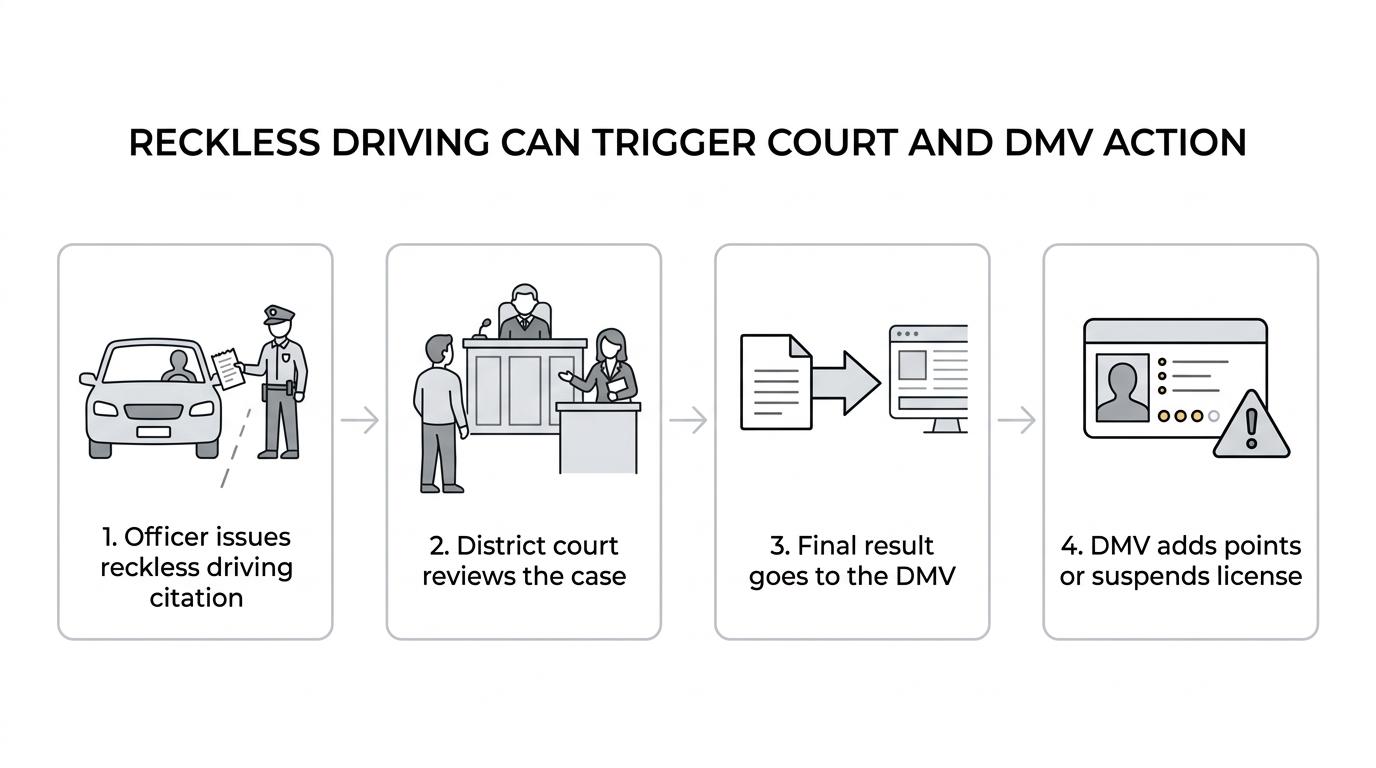
Then comes the decision point. If the evidence is weak, the record is favorable, or the facts support a lesser charge, the outcome may be different from the original citation. If the state’s evidence is strong and the record is poor, the strategy changes. The key is that process matters. Reckless driving cases are often shaped by preparation long before the judge hears the case.
How do DMV points and license suspensions work after reckless driving?
A reckless driving conviction can affect your license in more than one way due to the potential liability involved. North Carolina assigns 4 driver-license points for reckless driving, and separate suspension rules can apply when speeding and reckless driving happen on the same occasion.
The North Carolina Driver Handbook is the clearest starting point. It lists 4 driver-license points for reckless driving. For commercial motor vehicle violations under G.S. 20-140(f), careless and reckless driving is listed at 6 points. That difference matters if you hold a CDL or drive for work.
The point system also compounds over time. NCDOT says a license may be suspended if a driver accumulates 12 points within a three-year period. If the license has already been reinstated after a suspension, 8 points within three years can lead to another suspension. At 7 points, a driver may be assigned to a driver improvement clinic, and satisfactory completion can deduct 3 points.
A common mistake is treating a reckless driving case as if the only issue is the fine and ignoring the potential negligence associated with such an offense. It is not. The DMV receives final convictions from the courts, and its review is separate from what happened in the courtroom. If you are already carrying points, then one new conviction can change the risk level quickly.
Is reckless driving worse than speeding in North Carolina?
Usually yes, because reckless driving is its own misdemeanor. A speeding case may remain an infraction, but reckless driving adds criminal exposure, and speeding plus reckless driving together can trigger a 60-day suspension under NCDOT rules.
That comparison matters because many Greensboro citations include both a speed allegation and a reckless driving allegation. If both remain in place, the risk is not just additive. It can change the suspension analysis entirely. NCDOT specifically lists speeding and reckless driving on the same occasion as a basis for a 60-day license suspension.
“Jason Aycoth Criminal Lawyer | DUI | Traffic Tickets | Car Accidents includes three former Guilford County District Attorneys, a concrete point of local courtroom experience for Greensboro traffic and criminal cases.”
Drivers also assume that reducing the speed alone solves everything. Sometimes it helps, sometimes it does not. If the reckless count remains, the criminal piece remains. If the reckless count is addressed but the speed is still very high, other consequences may still follow. That is why charge-by-charge analysis matters more than broad labels like “just speeding,” especially considering potential negligence.
What should you do in the first 48 hours after a reckless driving citation?
Act quickly and methodically. The first 48 hours should focus on preserving facts, checking deadlines, and avoiding statements that can make later negotiations or trial preparation harder.
Small details fade fast after a traffic stop. Road conditions, lane positions, weather, traffic flow, and where the officer first observed the vehicle can all matter. If there was a passenger or another witness, their memory may be clearest within a day or two, not weeks later.
A practical first pass looks like this:
- Verify the charge: Read the citation closely and note whether reckless driving is charged alone or with speeding or another offense.
- Calendar the court date: A missed date can lead to a failure to appear and an indefinite suspension until the case is resolved.
- Pull your driving record: NCDMV offers official driving-record requests, and prior points can change strategy.
- Preserve your own evidence: Save dashcam footage, photos, maps, receipts, or phone location data if they help place you on the road.
- Avoid casual admissions: Do not “clear things up” with long messages, posts, or calls that can later be repeated in court.
If you drive commercially, hold an out-of-state license, or were involved in a crash, urgency goes up. Those facts can change both the practical risk and the best sequence of next steps.
Can a reckless driving case be reduced or resolved without a full trial?
Yes, many North Carolina traffic cases are resolved without a full trial. The right outcome depends on the facts, liability issues, the driving record, the prosecutor’s position, and whether the evidence fits a lesser offense, a dismissal argument, or a trial posture.
The North Carolina Judicial Branch makes clear that traffic matters often move through guilty pleas or trials before a district court judge. That leaves room for negotiated results in appropriate cases. A resolution might involve a reduction, a dismissal, a continued case, or a hearing on the evidence. Which path makes sense depends on what the state can prove and what collateral consequences matter most.
One misconception is that “showing up and apologizing” is a strategy. It usually is not. A better approach is to identify what actually drives risk in your case. If the main problem is the criminal label, then charge reduction may matter most. If the main problem is point exposure, then the DMV effect may drive the plan. If the evidence is flawed, then pushing toward trial may be reasonable.
That is also why early record review matters. A driver with few prior issues may have options that look different from a driver already near the 12-point suspension threshold.
When should you call a reckless driving attorney in Greensboro?
You should call early, especially if speed, prior points, a CDL, an out-of-state license, or an accident is involved. Jason Aycoth Criminal Lawyer | DUI | Traffic Tickets | Car Accidents is one Greensboro example of a firm focused on criminal and traffic defense.
The timing question is simple. If the charge can affect your criminal record, your license, your employment, or your insurance position, getting legal analysis before the first court date is usually smart. Waiting narrows options, especially when records need to be checked and court strategy needs to be built around both the charge and the DMV impact.
This is even more urgent if you missed court, received multiple charges from the same stop, or already have points on your record. If one conviction could push you toward suspension, then the case is no longer just about one ticket. It is about protecting your ability to drive, work, and keep the issue from growing into something much harder to fix later.